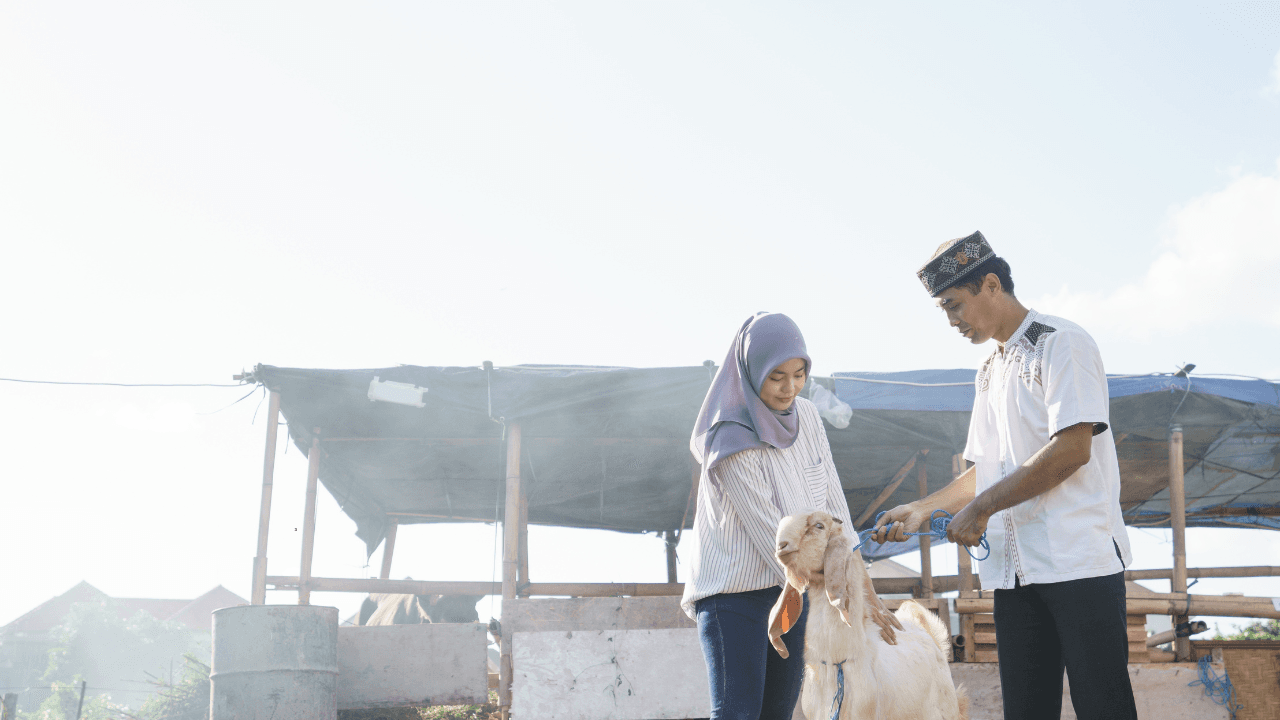
Eid al-Adha 2026 falls on approximately May 27, which is 10 Dhul-Hijjah 1447. If you are a Muslim American who has not yet arranged your Qurbani, you have a few days. This guide covers what Qurbani is, who is required to give it, what your options are in the U.S., and what happens if you miss the window.
Ready to compare halal options?
Qurbani and Udhiyah: the same act, different names
Qurbani (from Arabic qurban, meaning sacrifice or nearness to Allah) and Udhiyah (the classical Arabic term) refer to the same practice: the slaughter of a specific animal during the days of Eid al-Adha in commemoration of Ibrahim's (peace be upon him) willingness to sacrifice his son. South Asian and many Arab communities tend to say Qurbani; classical texts use Udhiyah. Same obligation, same rules.
Is Qurbani obligatory or optional?
This depends on your madhab. The Hanafi position is that Qurbani is wajib (obligatory) for every adult Muslim who possesses wealth above the nisab threshold on the days of Eid and is not a traveler. The Maliki, Shafi'i, and Hanbali schools classify it as sunnah muakkadah: strongly encouraged and carrying serious weight for those who neglect it without valid reason. The Hanafi opinion is the majority position among U.S. Muslims with South Asian heritage; the sunnah muakkadah view is common in Arab and African communities.
The nisab threshold is the same reference point used for zakat: the value equivalent to approximately 87.48 grams of gold or 612.36 grams of silver. Use the HalalWallet zakat calculator to check the current nisab in dollar terms before Eid.
Who counts as one share?
A sheep or goat counts as one Qurbani for one household or one person, depending on the scholarly opinion you follow. A cow, bull, or camel can be shared among up to seven people, with each contributing one share. The animal must meet minimum age requirements: sheep and goats at least one year old (some scholars permit six months for sheep), cows and bulls at least two years, camels at least five. The animal must be free from obvious defects.
The window for Qurbani in 2026
Qurbani begins after the Eid prayer on 10 Dhul-Hijjah (approximately May 27, 2026) and continues through the end of 12 Dhul-Hijjah according to the majority position, or through 13 Dhul-Hijjah according to the Hanbali school. That gives U.S. Muslims a window of approximately May 27 to May 30. Sacrifices performed before the Eid prayer are not valid. If giving through a charity, confirm they slaughter within this window.
Qurbani options for U.S. Muslims
You have two main paths: domestic sacrifice or giving through an Islamic charity that performs the sacrifice on your behalf, typically in a lower-income country where the meat reaches families in need.
Domestic sacrifice means arranging for a halal slaughterhouse or farm near you to sacrifice an animal during the Eid window. Some mosques organize community sacrifices. The meat is distributed locally, often divided into thirds: one third for your family, one third for relatives, one third for those in need. Domestic Qurbani costs significantly more than international options because of U.S. livestock and labor costs. Contact your local mosque or a halal butcher for current pricing and availability.
International Qurbani through a charity means paying an Islamic relief organization to perform the sacrifice on your behalf in a country where the cost is lower and the meat reaches more families. Organizations such as Islamic Relief USA, Zakat Foundation of America, ICNA Relief, and HHRD all run Qurbani programs. Pricing varies by country and organization. Confirm before paying that the charity sacrifices within the valid Eid window and that the animals meet Islamic requirements.
Domestic vs. international: which is better?
This is a genuine fiqh discussion. Some scholars argue the sacrifice should be performed locally because the sunnah of the Prophet (peace be upon him) was to sacrifice in the same location as the worshiper. Others hold that giving internationally is permissible and more impactful because the meat reaches families in acute need. Both positions have scholarly support.
A practical middle path: give one share domestically to participate in the community sacrifice and connect to the sunnah locally, and give additional shares internationally if your financial situation allows. If budget requires choosing one, either is valid according to the majority of contemporary scholars.
Get every halal provider graded (free PDF)
Every US halal provider graded on Shariah integrity, transparency, and value - the full scorecard PDF, plus alerts when grades change
No spam ever. Unsubscribe in one click.
What if you miss the Qurbani window?
If the days of sacrifice pass and you did not perform Qurbani despite having the means, the Hanafi position is that you should give the equivalent value in sadaqah as compensation. The other schools do not prescribe a specific kaffara but consider the missed Qurbani a failure to observe a confirmed sunnah. Give what you can as sadaqah and make the intention to fulfill Qurbani next year.
Qurbani and your broader Eid giving
Eid al-Adha is one of the highest points of the Islamic charitable calendar. Many Muslims who have not yet paid their annual zakat use the occasion to settle it alongside Qurbani. Use the HalalWallet zakat hub to calculate your zakat obligation and find where to give. If you are also completing Hajj prep this week, the Hajj 2026 preparation checklist covers the full financial and estate-planning picture for pilgrims. And if you want charitable giving to continue generating reward after you pass, our Islamic wills and estate planning guide explains how to include a charitable bequest in your wasiyyah.
Frequently asked questions
When is Eid al-Adha 2026?
Eid al-Adha 2026 corresponds to 10 Dhul-Hijjah 1447, falling on approximately May 27, 2026. The exact date may shift by one day depending on the official moon sighting. Hajj 2026 begins May 25 (8 Dhul-Hijjah), meaning Eid and the Qurbani window follow two days later.
Can one Qurbani cover an entire family?
According to the Hanafi school, Qurbani is an individual obligation on every adult household member who meets the nisab threshold. Under the other schools, one sacrifice suffices for the household. Most contemporary fatawa for Western Muslims follow the more flexible position that one sacrifice can cover a family unit, but individuals who want to be cautious give one share each.
Is Qurbani required if you are paying off debt?
If your debts are deducted from your assets and the remainder falls below the nisab threshold, Qurbani is not obligatory under the Hanafi position. If you have net assets above nisab despite your debts, the obligation stands. If you are in genuine financial hardship, you are exempt. Give what sadaqah you are able to.
Can I give Qurbani on behalf of someone who has passed away?
Yes. Giving Qurbani on behalf of a deceased parent, relative, or spouse is a recognized and encouraged practice. The majority of scholars permit it and hold that the reward reaches the deceased. It is typically performed in addition to your own Qurbani, not instead of it, if you have the means.
Compare providers in your state
See side-by-side comparisons of Shariah-compliant products, or let our matcher recommend the best options for your situation.
How do I know if an international Qurbani charity is valid?
Confirm three things before paying: that the sacrifice happens within the valid Qurbani days (10 to 12 or 13 Dhul-Hijjah), that the animals meet minimum age and health requirements, and that you receive confirmation of the sacrifice. Reputable Islamic charities with established Qurbani programs, such as Islamic Relief USA and Zakat Foundation of America, typically provide all three.